

Hey all 👋! I’m currently recovering from my functional rhinoplasty (more on that below), but spoiler alert: It sucks 😩. One upside of sharing these interventions publicly is hearing from you on what you like/don’t like in health. That said, I’m always thinking about how to make 5HT more useful (and fun). So if you’ver got three minutes, take this survey to tell us how I can improve! As a thank you, you’ll gain access to our super-duper 5HT+ Slack channel. 🤩
#1 Recovering from my nose job
Here’s me pre-nose job:

Here’s me after:

But really, it's been terrible.
I couldn’t breathe through my nose for almost a week. My tongue and mouth felt burnt. Couldn’t taste anything. My eyes were swollen and light sensitive and tearing and furious. Laughing made me cry. Crying made me laugh. (Okay, not that exactly.) But everything hurt. And for several days, I looked like a raccoon who lost a bar fight. Thankfully, eight days in, I’m now feeling (and looking) much better.
But first, let’s take a step back. What was this nose job, exactly?
Well, here’s exactly what Dr. David Nolen, my tremendous doctor from Austin ENT, did:
*Warning: I get detailed, so scroll if you’re squeamish!
First, to gain access, he performed an open rhinoplasty (making a small incision between the nostrils) so he could fully lift the skin and see what he was working with. This allows for precise structural work vs. working blindly from inside the nostrils.
Then, to solve for my…
👃🏻 Severely deviated septum, he removed and reshaped the crooked septal cartilage (the softer front part) and the vomer bone (the bony back portion of the septum) to straighten the airway.
👃🏻 Curved vomer bone, he carved a thin straight bone piece, drilled small holes (!), and created an internal splint for reinforcement (think like a brace inside the septum).
👃🏻 Narrow internal nasal valves, he placed spreader grafts to widen and structurally support the airway. (FWIW, this is a very common breathing bottleneck.)
👃🏻 Minimal septal cartilage, he used a ribe from a cadaver (yes, a dead person’s rib 💀) to reinforce and stabilize the nose long term.
👃🏻 Enlarged inferior turbinates (basically structures inside the nose that warm and humidify air), he reduced them to create more breathing space.
👃🏻 Bony irregularity along the bridge of my nose, he rasped (filed down) the nasal bone to smooth and properly align it.
Finally, he reinforced the entire nasal framework with structural cartilage grafting to keep the airway stable and durable (and prevent future airway collapse).
And he did all this, methodically, slowed down by what he said was extra oozing 🥴 which he claims is common in healthy people who take a lot of Omega-3s.
Yeesh.
Point is my nose was really messed up. But now it’s not. Aaand as of yesterday, I feel like I can breathe better than I’ve ever breathed before. Like, breathing air into my nose goes all the way up to the top in a way I’m not sure I’ve ever felt or known was possible. It’s pretty incredible.
On the other hand, now my nose looks like it got stung by a bee, and I look like a cartoon version of myself. I’m told this will get better over the next few months, but won’t really be done until a year from now (!).
The good news is that the first week of recovery is over. Also, Dr. Nolan himself said my (almost no) bruising was as good as it gets. And I think the #1 thing I have to thank for that is…
#2 HBOT
HBOT (Hyperbaric Oxygen Therapy) was on Dr. Nolen’s list of recommended interventions to help with post-op swelling and tissue healing, so I’ve been going to ATX Hyperbarics for the last week (shouts to them, they were great). Five proper sessions in, seems he was right!
I actually first tried HBOT at Eudēmonia, but I was only in there for 20 minutes, which, apparently, is like doing a few Russian twists and expecting abs. (The real benefits tend to show up after 1-2 hours.)
Basically, you go into this special chamber that involves breathing pure oxygen at increased pressure 😮💨. The way it works is that under high atmospheric pressure, your body dissolves significantly more oxygen directly into your blood plasma—not just what’s carried by hemoglobin. That extra dissolved oxygen can reach tissues even when circulation is compromised (byeee swelling, bruising, inflammation post-surgery 👋). The oxygen also supports fancy processes like collagen synthesis, angiogenesis, and immune function.
Experience-wise, I didn't loveee the pressure shifts. It felt a little like taking off/landing on an airplane. They did give me chewing gum, because the constant swallowing and jaw movement helps with adjusting to the pressurization. One day I forgot to get the gum, and I had trouble popping one ear. They quickly adjusted the pressure, and all was well.
Now, what I did love was getting to read. A lot. You can’t bring metal (aka your phone) into the chamber, so I brought books. I finished book seven of the Dungeon Crawler Carl series (absurd, delightful, and I enjoyed every second) and I finally started Red Rising (yes, I know I’m late). I clocked 7.5 hours of uninterrupted reading. 😱
Also, HBOT is actually FDA-approved for a ton of conditions—from carbon monoxide poisoning to decompression sickness to severe burns. While the evidence for cosmetic surgery recovery is smaller and more mixed, the mechanism is both biologically plausible and, turns out, regularly recommended.
Bottom line: I’m into it. And if you reply with what I should read during my next HBOT sesh, I might reply with a photo of me post-op. 👊🦝
#3 AI health data privacy
I saw an article on The Verge making the rounds recently about why putting your healthcare info into AI is a terrible idea. Reactions ranged from dystopian to dangerous to a no-good, very bad idea.
My reaction, as usual on this topic, was… not that.
In fact, I want AI to have my health data.
Most of us are already sharing a massive amount of our health data, happily. We upload labs to portals. We strap on wearables. We track our sleep and HRV rates. We log food, symptoms, moods, and medications. All of those are opportunities to take, steal, or manipulate our data.
So the idea that our data is pristine and private is, at best, IDK a comforting fiction?
I think instead of “Is my data perfectly private?”, we should be asking more like “Who’s giving me more value for my data than the risk of exposing it?”
And, for me, AI is at the waaay top of that list. AI tools help me:
👉 Understand my labs better than most doctors have time to.
👉 Synthesize messy, fragmented information from multiple sources.
👉 Spots patterns I'd never see.
👉 Answer one-off (sometimes silly or uncomfortable) questions instantly so I don't need to ask somebody fancy.
👉 And helps me prepare better questions for when I finally do get seen.
For example, thanks to AI, I went into my pre-op nose job appointment with a full list of potential interventions (some medical, some more woo) that could help improve my recovery—and asked my doc’s opinion on them. (I also just asked AI when it’d be okay for me to go on a rollercoaster 🎢 again—a question I’d never ask an actual real life person seriously. 😆)
Ultimately, the trade off feels super fair to me.
I also don’t believe my cholesterol panel is uniquely catastrophic if it leaks 😂. Definitely not compared to my financial credentials, kids’ identities, or location history. Not all data carries equal risk, and treating all of it as sacred muddies the conversation.
I’m not saying there isn’t any risk from giving data to AI health tools, but it's definitely nuanced and the harm is mostly hypothetical (whereas the benefit is immediate and tangible). So, in the meantime, I’m making a conscious trade: Some future uncertainty in exchange for very real present clarity and support at a level I've never had before.
My thinking could change. My data might become more sensitive. The incentives might worsen. Regulation may lag. There might be a point where the balance tips, and I say no thanks.
But for now: take my data, Claude.

#4 The fake wellness monk
Here’s where AI ain’t so fly.
Turns out, that one viral Buddhist monk you might’ve seen sharing motivational teachings and wellness advice on your social feed is, well, AI-generated. 😬
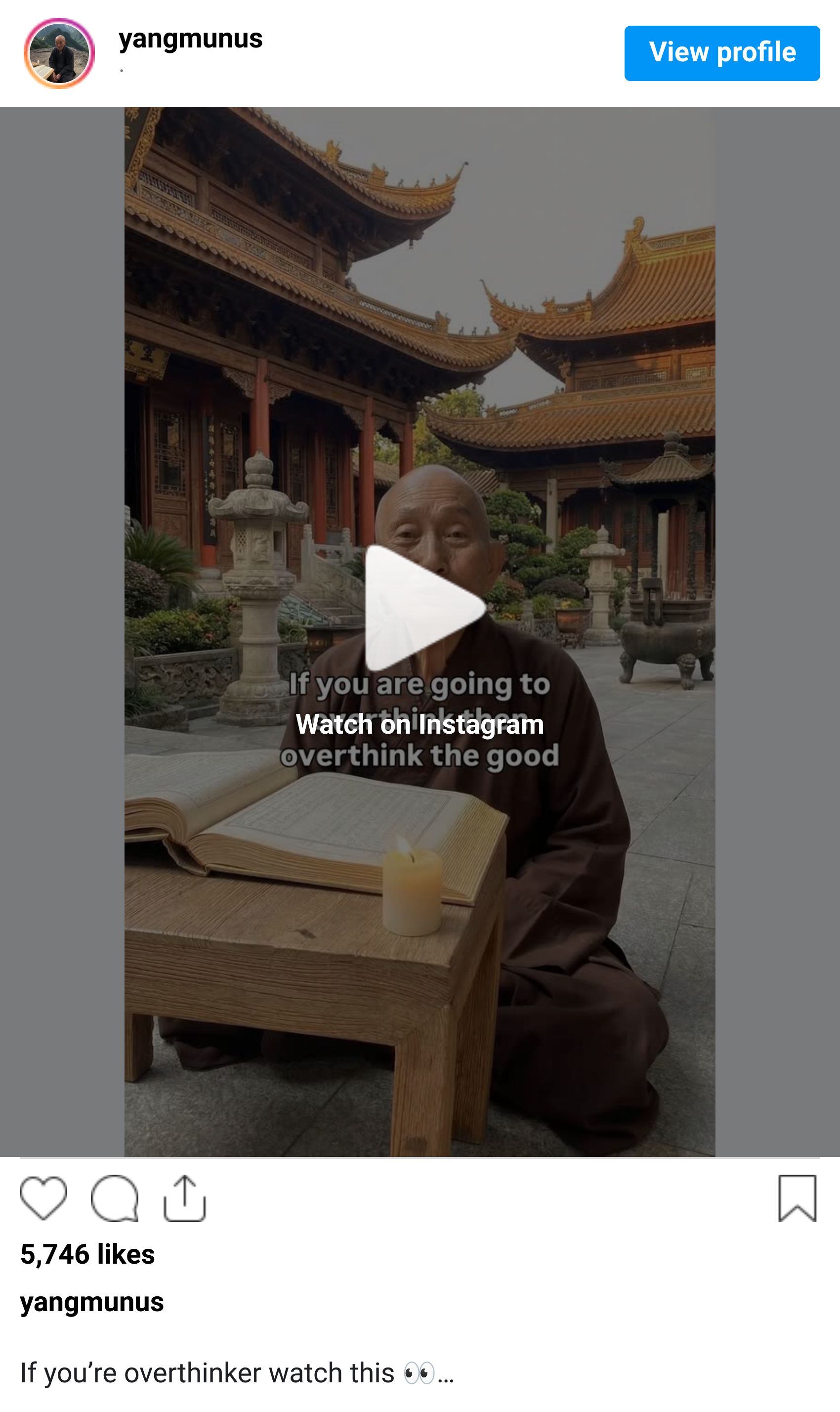
While an AI label does exist on @yangmunus content, people across Reddit, wellness podcasts, and Instagram are calling the character misleading at best, deceptive at worst. I mostly agree, especially since they’re using this fake monk to sell “ancient teachings.” 🙄 And, FWIW, my earlier argument on the value of using AI was for getting clarity, whereas this is giving snake oil.
I do think this isn’t the future, it’s now. Time to, er, get increasingly more skeptical on which AI monk you get your advice from.
#5 Toku
Between my ER visit and heart surgery, heart health has been increasingly top of mind. One thing I’ve been depending on is Toku Flow, a nattokinase-based supplement for heart health I added to my afternoon smoothies after it launched last year.
Basically, nattokinase is an enzyme extracted from natto, a traditional Japanese food made from fermented soybeans. The enzyme works harddd for your heart, and has been shown to support cardiovascular health across numerous clinical trials.
In one 12-month study of 1,062 participants, results showed 10,800 FU (Fibrinolytic Units) of nattokinase + Vitamin K2 led to meaningful improvements in coronary plaque health, arterial flexibility, and cholesterol markers. My overall takeaway has been that this is a very non-medical yet functional way to support your heart. ❤️
But what really makes me stok(u)ed 😏 is Toku customers are now sharing their actual bloodwork in exchange for insights and incentives. We're talking ApoB, triglycerides, lipid panels—the works. It’s all part of a program Toku is running called the Heart Health Journey, and the way it works is:
Share your baseline labs
Take Toku Flow daily for 90 days
Re-test and share your updated results
Get up to 50% reimbursed on your first 90-day supply + 25% off your next order
IMO, this is exactly the kind of accountability most supplement companies avoid, and I super dig what Toku is doing with this program. It’s also exactly what I was talking about above on the value of sharing your data!
If you're someone who tracks (or wants to start tracking) heart health markers, this is a low-risk way to answer the "is this working?" question with your own numbers.
Annnd because founder Justin Eaton’s a friend, 5HT readers get an additional 20% off! Use code “HEALTHYISH” to get your discount.
⚡ Neural hacks
Directions: Copy and paste the below prompt into your AI platform of choice to create a personal, weekly mantra. (Aka become your own motivational influencer.)
Act as a thoughtful mindfulness coach.
Ask me 3 quick questions about how I’m feeling, where I might be holding back, and who I want to show up as this week, and then create one non-cringey mantra (under 12 words) that can help ground me throughout the next seven days.
Make it clear, empowering, and easy to remember.
🍿 Brain snacks
The “Fitbit for Farts” is coming. Because of course it is. 😅
Also coming soon: Protein Jello.
The new oral Wegovy already has a nickname. People are calling it the last 20 pounds’ pill.”
GLP-1s are also getting people to exercise more. +1 for lifestyle change!
Grail’s cancer detection test fails in a major study. Pretty disappointing 😔 and I plan to get into this deeper in a future edition.
Kindbody founder Gina Bartasi announced her new AI-native fertility platform.
Function launches a smoothie with Erewhon. (TBT to their $19 strawberry 🍓.)
Pediatric therapy company Coral Care announces $13M fundraise.
Oura launched their own LLM (now in testing) for women.
The first shelf-stable, 100% human-donor breast milk powder is here.
Research shows stopping food 3 hours before bed ⏰ leads to pretty dramatic improvements.
The microplastic conversation enters oral care. (And I bet every other product category next.)
Apparently, Olympic athletes are drinking these broccoli sprouts to lower lactate levels?
Metformin (which I wrote about here) is gaining popularity for weight loss.
Braden Peters’ “looksmaxxing” approach caused quite a stir in our 5HT+ Slack channel. 😬
Oh—and I guess Zara sells gym stuff now? (H/t Liz Plosser)
Most clicked last week: Boy kibble in at #1.
Shoutout to Marie C, Nora L (MVP), Ross H, Kathryn O, Jessica L, Catarina D, Shaun C, Cristina V, Kate N, and Tanya E for sending emails or contributing to 5HT+ Slack community!
Want in on 5HT+? Two referrals get you in. Share your unique code, and join the chat. → {{ rp_refer_url }}
👋 Who are you again? I’m Derek Flanzraich—founder of two venture-backed startups in Greatist (👍) and Ness (👎). I’ve worked with brands like GoodRx, Parsley, Midi, Ro, NOCD, and Peloton. I now run Healthyish Content, a premium health content & SEO agency (among other things).
Every Thursday, I share 5 health things I feel strongly about so you can live healthyish. (Disclaimer: I’m more your friend with health benefits. None of this is medical advice.)
And oh, you also feel strongly about some health things? Hit reply—I’d love to hear it.