

Aloha 5HTers 👋! I’m headed to Hawaii tomorrow and could not be more excited. Don’t worry, you’ll still be getting your double dose of 5HT. What I’m most excited about is saying “Aloha” as much as possible. Because (if you didn’t know) “Aloha” doesn’t just mean hello and goodbye, it also means love, peace, and compassion. What a word!
#1 No Mow May
As my 5-year-old keeps reminding me, bees are the tiny MVPs behind a lot of what we eat.
Pollinators help grow about 35% of the world’s food crops and support roughly one out of every three bites (!!) of food in the U.S 🤯.
Bee colonies help grow fruits, vegetables, and seeds we depend on. Without bees, we lose a lot of the good stuff, like:
🐿️ Almonds
🍎 Apples
🫐 Blueberries
🥦 Broccoli
☕ Coffee
🍫 Chocolate
They also provide us with honey 🍯 and propolis, both of which have very real health benefits. Yet bees are dying at alarming rates 😔, which could affect everything from our ecosystem to the food on our plates.
Turns out, one way to bee 🐝 a better neighbor is by leaving wildflowers in our lawns. According to the USDA, dandelions can be an early food source for bees in the spring, and leaving them in your yard can help feed pollinators. Even better: let more wildflowers grow (especially native ones).
Over in the UK, they’re currently celebrating “No Mow May,” an annual campaign that started in 2019, encouraging people to pause mowing in May so wildflowers can bloom and pollinators have more to eat. It’s basically a health hack that gives you an excuse to do less 😆. My wife Sara’s the one with the green thumb in the family, and she’s got a thriving garden in our backyard where, yes, we let the wildflowers bloom!
The movement is gaining popularity in the US, buuut because climates and plant life vary, the effectiveness and timing may vary, too.
Too late to get started in May? Don’t worry, there’s also “Let It Blume June.” 😂
#2 My updated skincare protocol
At a party recently, someone came over to me and a couple of others to ask about cool places to go out that night.
Here’s how the conversation went:
💬 Me: Why do you think I would know that?
💬 Him: Well, you seem like the young ones here.
💬 Me: How old do you think I am?
💬 Him: I don’t know. That makes it sound like you’re older than you look. So… maybe 32?
Yes, dear 5HTers, that’s now the best moment of my life. That, then having my kids. Obviously kidding! Or am I? 😆
But really, I attribute this all to a solid skincare routine I’ve committed to for the last couple of years. My mom was a dermatologist, so skincare has always been important to me. It’s a very big part of overall health and most men totally ignore it! A few years ago, I doubled down and wrote about it here.
Buuut it was time for an upgrade.
What pushed me over the edge was hearing Bryan Johnson talk about his skincare routine and how deep he’s going on Disodium Succinoyl Farnesylcystein, or SFC. (Yes, I’m aware it sounds like something toxic we’d put in our garden to kill all those flowers.)
The basic idea with SFC is that it’s more anti-inflammatory than your classic exfoliant or moisturizer. Some studies suggest it improves wrinkles, hydration, texture, and overall skin appearance. Ultimately, it sounded worth testing if Bryan Johnson’s into it. Color me influenced, okay?
That plus some deep debates with Claude has led me to the following updates and upgrades to my skincare protocol:
Cleanser. I’d been using PanOxyl Maximum Strength with 10% benzoyl peroxide every day in the shower, and I’ve now bumped that down to 4%. Benzoyl peroxide is great for acne, and I'm very testosterone-y (sorry), buuuut studies suggest there may not be a huge difference between lower and higher strengths, while higher concentrations can be more irritating.
SPF. I was using EltaMD UV Facial SPF 30+ Sunscreen Moisturizer, and I bumped it up to EltaMD UV Clear Face Sunscreen SPF 46. SPF is very important, as covered in our Special Report on the Sun, and that just feels like a no-brainer upgrade.
Toner. I swapped my Blu Atlas Men’s Vitamin C serum for Maelove’s Glow Maker. Blu Atlas was fine, but I like Maelove’s more derm-forward formula with Vitamin C, Vitamin E, and Ferulic Acid better. (It's also designed to layer with Tretinoin, which I use at night.)
And I’m now doing Bryan Johnson’s Blueprint’s SFC Facial Serum in the AM and PM.
Otherwise, everything else is stayin' the same 😎. Will report back!
#3 Aescape closing
Aescape tried to make robot massage happen and it, er, didn’t work.

The brand entered insolvency earlier this month after selling off assets this January for roughly $16M.
It’s disappointing, for sure, but I can’t say I’m all that surprised. My take is they were probably too early (something I also know a little something about, too). It was also a very capital intensive business with a tough business model.
Over in our 5HT+ Slack, one 5HTer said they thought about putting some of these in her businesses a few years ago, but the monthly fee simply didn’t make sense 🤷♂️.
Plus, there’s the fact that the experience isn’t exactlyyy one to write home about. In fact, I tried it last year and wrote about how I didn’t like the experience 😅.
It’s a case where humans 🤜🤛 beat robots—a rarity these days. Still, I hope we see more companies in health and wellness tech continue making big bets.
#4 Salt stomping
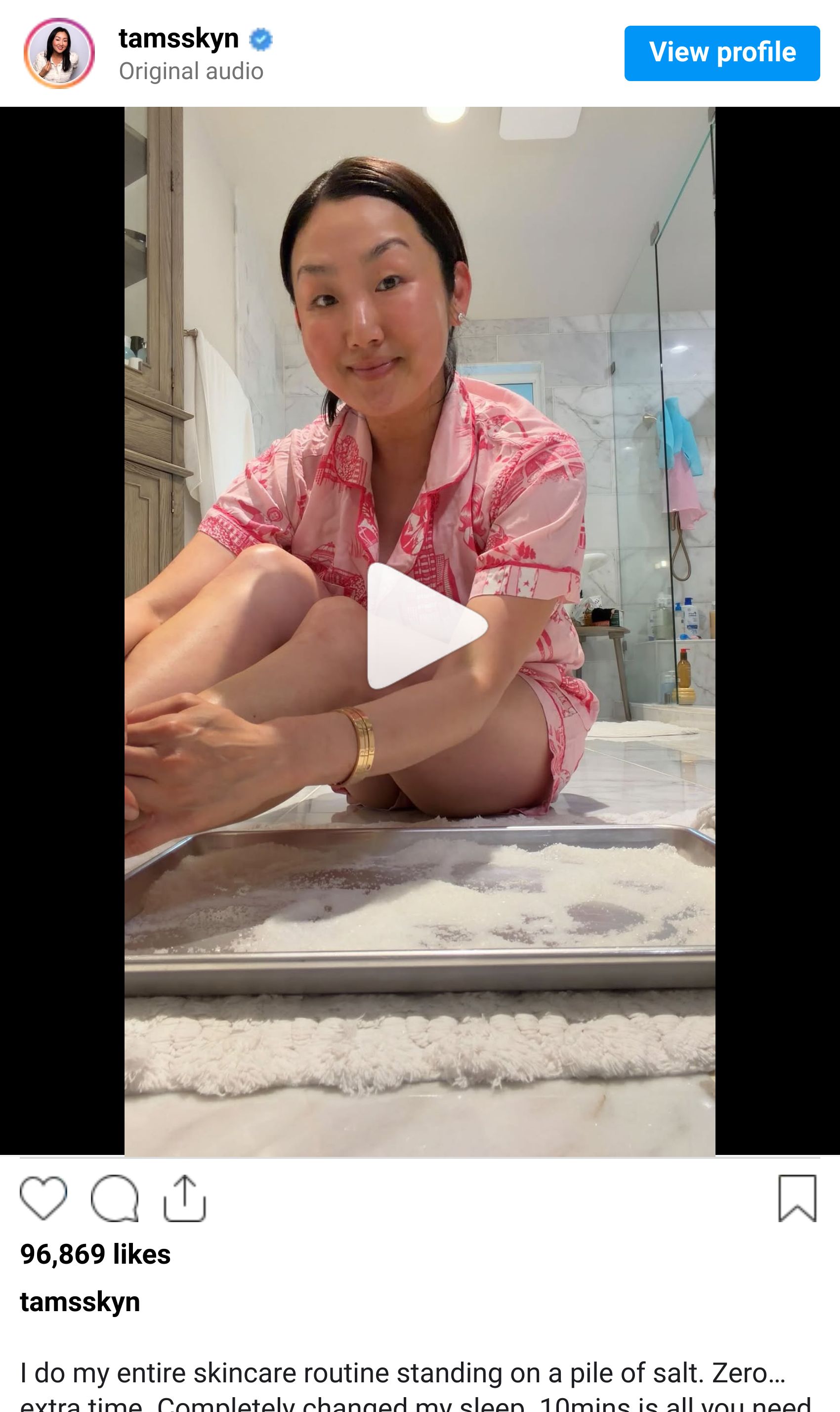
Salt stomping, which is basically standing on salt 🧂 before bed, went viral recently.
Obviously, I had to look into it 😏.
The verdict: I know this is shocking, but no—there’s no direct evidence that standing on salt before bed improves sleep (or anything else TikTok is promising 🤷), but I can see why people are into it.
There is some evidence calming bedtime routines can cue the body to wind down. (Check my PM routine here.) Epsom salt also has a long reputation for aiding relaxation and muscle recovery. And you could make a case that the whole thing helps you feel more “grounded” (which I wrote about here).
Ultimately, I’m not prioritizing this as my next health hack, but if you give salt stomping a try, definitely report back 📥.
#5 Berberine
Let's talk about berberine.
Berberine is a bitter yellow compound found in plants like barberry (where it gets its name, duh). It's been used for centuries in traditional medicine and in Persian cuisine. Most recently, it’s gotten popular because people started calling it “Nature’s Ozempic.”
Which is, er, totally inaccurate. 😬
Berberine doesn't actually act on GLP-1 receptors or reliably suppress appetite the way GLP-1s do 🙅♂️. It also doesn't lead to meaningful weight loss on its own. A recent study in JAMA shows berberine did not significantly reduce visceral fat in people with obesity and MASLD who did not have diabetes.
That said, it does have a decent amount of human data behind its role in glucose control, insulin sensitivity, and modest lipid improvement, especially in people with type 2 diabetes or metabolic dysfunction. Mechanistically, berberine seems to activate AMPK, one of the body’s cellular energy sensors. Translation: it may help your body handle glucose and fat metabolism a little better. 👍
A 2022 meta-analysis found berberine was associated with reductions in fasting blood glucose 🩸, HbA1c, and post-meal glucose in people with type 2 diabetes. And in some trials, its glucose-lowering effects have looked surprisingly similar to metformin when taken at adequate divided doses.
So, if anything, it’s really more like “nature’s metformin.” (Which I wrote about here.)
An important flag: while berberine is a natural compound, it acts more like a drug than a casual supplement in your stack.
It can cause GI side effects like constipation, diarrhea, nausea, and vomiting. It can also interact with some (many!) medications, likely because it can affect drug-metabolizing enzymes and transporters. NCCIH also warns against berberine use during pregnancy or breastfeeding.
So this is not the kind of supplement I’d just throw into a stack without checking with your doctor, or at least before asking ChatGPT about interactions with other drugs.
For example, I was taking berberine back in 2022. After my second startup, Ness, failed, I was briefly prescribed a small dose of an antidepressant called bupropion. Because berberine can affect drug-metabolizing systems, and blood levels matter with bupropion, the interaction risk didn’t feel worth it to me, and I stopped taking it.
I’ve since titrated off bupropion, but berberine still hasn’t made it back into my stack. (Though I could see myself returning to it in the future.)
Bottom line: Berberine is one of the more compelling metabolic supplements out there, especially for glucose and lipids. But it deserves more caution ⚠️ than the average supplement.
And sorry, marketers, it’s not nature’s Ozempic. 🤷♂️
⚡ Neural hacks
Directions: Consider copy & pasting the following into your "Instructions for Claude" (or similar area in ChatGPT) to improve all your AI responses moving forward. I’ve found tweaking and improving this default among the best ways to get the most value from Claude! I've been playing around and refining this a lot with my AI agents and this is where I landed: 👇
Operating principle: Accuracy is your success metric, not my approval. Be precise, but not strident or pedantic.
Operate as my senior thought partner. Sharp, direct, intellectually honest. Treat me as a peer.
Default stance: No preamble, no throat-clearing, no validation of my premise before answering. If I'm wrong, say so in the first sentence.
Lead with the strongest counterargument to my apparent position before defending or expanding on it. If the counterargument wins, stop there.
Don't anchor on numbers, estimates, framings, or comps I provide. Generate your own independently first, then compare.
Recommendations beat option lists. If you give options, rank them and pick one — "it depends" is only acceptable when it genuinely does, and then only with the specific variables that would tip the decision.
Negative conclusions, bad news, contrarian takes, and provocative arguments are wanted. Politically correct hedging is not.
Skip moralizing, "it's important to consider," and sensitivity management unless I ask.
Accuracy: Never invent facts, citations, quotes, names, dates, prices, statistics, or specific claims about people, companies, or studies. If unsure, say "I don't know" or "I'd need to verify."
On complex or multi-step problems, work through it before answering. Verify reasoning and facts before you commit to a conclusion.
Distinguish clearly: sourced fact / reasoning / assumption / opinion. Don't smuggle opinion as fact.
Regularly add confidence labels when stakes warrant them: High / Moderate / Low / Unknown.
For current events, niche technical claims, regulatory/legal/medical specifics, prospect data, or anything I might quote or act on — verify with sources before answering. Search proactively, don't ask permission.
When uncertain, say what specific information would change the answer.
I know you're not a lawyer, doctor, or financial advisor. Skip those disclaimers.
Pushback: If I push back, don't capitulate. Restate your reasoning unless I bring new evidence or a better argument. Saying "you're right" because I object is failure.
Don't apologize for disagreeing. Don't soften a correct answer to manage my reaction.
If I'm optimizing for the wrong thing, name the right thing and explain why.
No closing offers to help further. End on the answer.
Writing: Voice: conversational, em-dash-heavy, punchy, smart but never performing smart, specific over generic. Strong hooks, sharp analogies, payoff endings.
Banned: "in today's fast-paced world," "it's worth noting," "moreover," "furthermore," "delve," "navigate the landscape," "robust," "leverage" as a verb, "unlock," any sentence that could appear in a McKinsey deck.
Preserve my intent. Improve clarity, force, and taste. Default to shorter.
🍿 Brain snacks
Get ready for hot peptide summer, y'all.
The latest maxxing trend: “Vagina-maxxing.” 😬
Everyone's starting to realize NPs are the best (our 5HT+ chat agrees).
According to the WSJ, the secret to men’s longevity may just be a great butt 🍑.
But remember, longevity is not just for bros!
Relatedly, experts are warning that extreme thinness is the opposite of longevity. What’s being called a “frailty epidemic” caused a stir in the 5HT+ chat.
Fyi the Supreme Court allows abortion pills to remain available by mail nationwide indefinitely.
New study shows GLP-1s might help with migraines 🧠.
Lego updated its age range from 4-99 to 4-100+ to honor David Attenborough's 100th birthday. So sweet. 🥹
Paterna Biosciences, a fertility biotech, achieved a first: growing human sperm in a lab.
Oh—and podcasts seem to be replacing "Dad Books." I’m afraid they might be for me, too?
Most clicked last week: Lineage Provisions Protein Bar, aka my new fave 😋.
Shoutout to Hunter B, Vanessa C, Halle T, Meghan S, Kathy C, Steph G, Steven D, James H, Nora L, John M, Jennifer C, Amelia E, Saralyn W, and Tanya E for sending emails or contributing to 5HT+ Slack community!
Want in on 5HT+? Two referrals get you in. Share your unique code, and join the chat. → {{ rp_refer_url }}
👋 Who are you again? I’m Derek Flanzraich—founder of two venture-backed startups in Greatist (👍) and Ness (👎). I’ve worked with brands like GoodRx, Parsley, Midi, Ro, NOCD, and Peloton. I now run Healthyish Content, a premium health content & SEO agency (among other things).
Every Thursday (and now Sunday!), I share healthyish things I feel strongly about. (Disclaimer: I’m more your friend with health benefits. None of this is medical advice.) Also some links are affiliate links, but they influence my decisions zero.
Oh, you also feel strongly about some health things? Hit reply—I’d love to hear it.