

Hey 5HTers 👋! Thank you to everyone (like 100s of you, jeez) who has been reaching out after my Mom’s passing. It means an awful lot. The fight continues, in her honor. 💪❤️
In this week’s edition:
A promising future for health insurance
What strategic wrinkles signal for builders
Using brand comparison to skip the line
Field notes: Does SEO even really matter?
Healthyish files: my Alzheimer’s prevention plan
#1 A promising future for health insurance
I’ve always had this vision of merging fintech and healthcare to help solve healthcare's broken incentive structure.
It’s partly why, years ago, I went on a quest to align incentives and created a health-first credit card. The thinking behind Ness was simple: people tend to keep their credit cards 💳 for years, so what if we could reward healthy spending and encourage better choices over time? Ness didn't end up succeeding, but I never lost sight of the vision.
My latest idea crush in this space is a better, tax-restricted savings account.
Basically, think of it like a souped-up, mondo HSA everyone can get (not just a universal HSA, but 2-3x its total size to capture health insurance spend). It’s limited by what you can spend it on—only health expenses—buuut you can use it toward health insurance, doctor copays, gym memberships, even supplements. It’d be the ultimate consumer health future, completely your choice what you spend it on.
The KEY is anyone can fund it. It could be funded by the government (think Medicare or Medicaid), an employer (think ICHRA-style bulk sums going into your account every month), or just your own money. And all of it tax-free.
I’ve often written about incentives in healthcare—and how game-changing it would be for health insurers to stick with you longer (rather than the 2-3 year average plan duration we have now), so they can justify investing in your preventative health more. These accounts would essentially work overtime. You can choose and fund longer-term health plans covering more things that’ll pay off later AND pay for other preventative things yourself, too.
I’m also not the only person thinking about this. I've heard this idea mentioned by a bunch of smart people recently, including Mark Bertolini, the CEO of Oscar Health, in this great podcast with Chrissy Farr. And it's really stuck with me.
Bottom line: I think this could be the future of a better healthcare system, but it’ll take regulatory changes—with co’s like Truemed (disclosure: I’m an advisor) and Thatch setting up to help manage this kind of account. The business model still seems a little unclear to me (for now), but I’m ultimately intrigued and excited about the potential here!
#2 Smooth foreheads are out
Apparently, smooth foreheads are out. “Strategic wrinkles” are in.

(And PHEW, because I’ve got many of them!)
I think this is the first of many pushbacks we’ll see as people get fatigued with longevity and -maxxing.
And that’s probably a good thing. As we overdo some of this stuff (see Bryan Johnson and the bazillionnnn articles about protein), there’s going to be a growing appetite for balance. It alsooo brings me back to the argument I made last month about not optimizing your life away.
For brands, this creates an opportunity to meet people where they actually want to be… not just where Instagram tells them they should be.

#3 Using brand comparisons to get ahead
From “the Graza of peanut butter” to “the Eight Sleep of office chairs,” brand comparisons are popping up everywhere in consumer health (and in 5HT).
They’re kind of a genius shortcut—and for good reason.
Basically, you get to build off the hard work somebody else already did. Having that framing can be tremendously effective in explaining what you do. When you say you’re “X for Y,” and if X is a brand everyone knows, you give them an instant reference point. Get it right, and it can crush (and save you a lot of work in the process).
Famously in tech, it was “Uber for X.” Even with my upcoming CPG brand, Fixie Dust, we’re saying “it’s like Pixy Stix, but for your brain” 🧠. One of my personal favorites is Throne’s “WHOOP for poop.” You immediately get it, and I think it’s genius. 😆
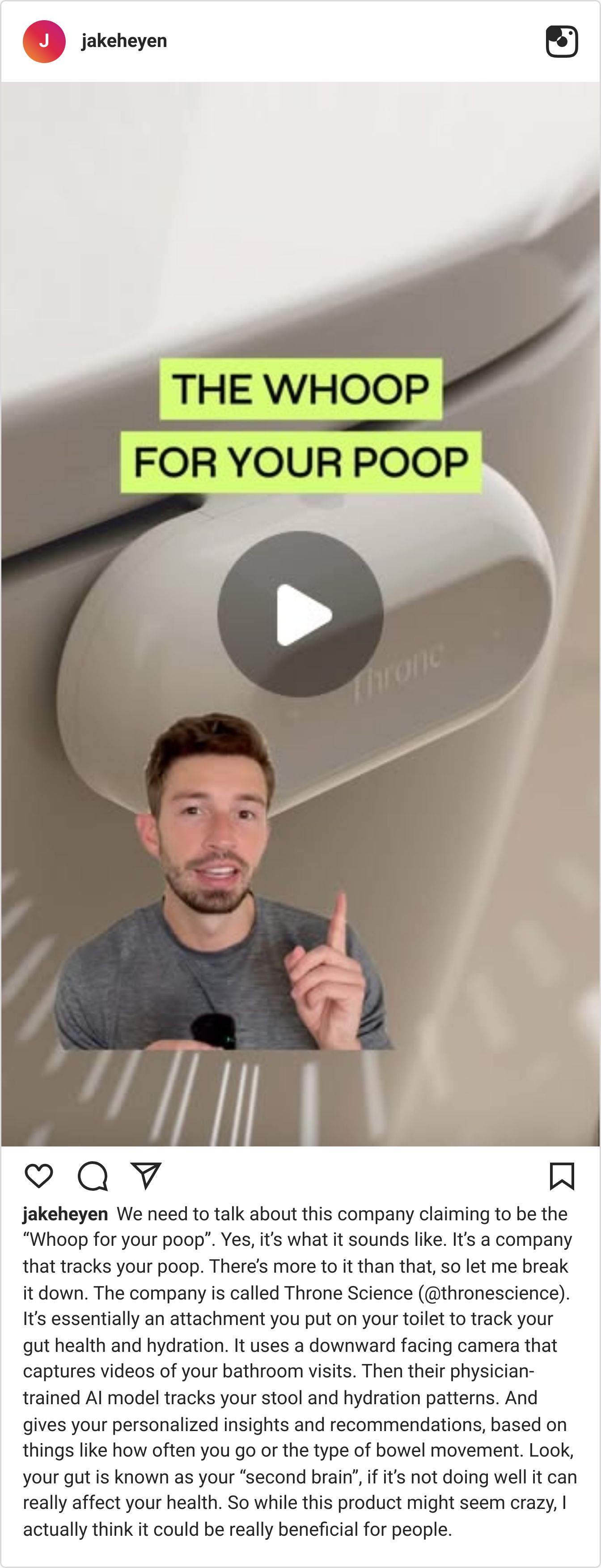
Now, two things worth considering before using this approach:
1️⃣ If you’re building a new category, it may be harder to skate off of another brand. Buuut not entirely impossible! In 2011, a16z used this very strategy when announcing Airbnb as their newest portfolio company, saying “Airbnb is to spaces what eBay is to products.” Airbnb was introducing a pretty unfamiliar concept, and the comparison gave people an instant mental model.
2️⃣ Know you inherit the whole brand, not just the part you want. What I mean here is: when you say it's “the Uber for X,” people also think of all the other things that come with Uber. The politics, controversies, and whatever else they associate with the brand. Brand perception matters, and it's worth considering if the shortcut is worth the baggage.
🗳️ Weekly Gut Check
Do you think selling to P&G was the right move for Thorne?
#4 Field notes: does SEO still matter?
I get this question weekly from health co builders.
Short answer: It's never mattered more.
The dirty secret of AI search is that ChatGPT doesn’t really know anything about your company. It grabs what’s already out there—and, overwhelmingly, what’s already ranking.
For the most part (across the 30+ co’s I advise and we work with at Healthyish Content), the content cited by LLMs is the same content winning in Google. It's essentially the same engine. Yes, there are ways to trick LLMs, buuut they rarely last.
For example, I got 5HT to rank for “best health newsletter” in ChatGPT using a bunch of tactics (primarily listicles and blogs). Then those tactics stopped working as the models got smarter. If anything, LLMs are evolving faster than Google, which means hacks matter less and long-term strategy matters more.
The good news: SEO & GEO are performing faster than ever. Work that used to take 6–12 months shows up in 3–6, sometimes month one. This is in no small part because so many competitors are pumping out AI slop.
That is why now is actually a uniquely great moment, especially for health co’s (where creating quality content takes more effort, clinical involvement, etc.) My point is: SEO isn't dead. Actually, I think it got a promotion.

Annnd if you don’t know where to start, start here:
📢 Feed LLMs what you want them to find. Have clear pages that answer real questions about your co. (A great FAQ page is key.)
📝 Write the best answer on the internet for your niche, not the most answers. Depth and quality always win.
🧐 Optimize your content for how LLMs read content. That includes having a summary up top, key takeaways at the bottom, if/then statements, etc.
🔗️ Build authority through external links, citations, and mentions. LLMs tend to care more about this than Google.
#5 Healthyish files: my Alzheimer’s prevention plan
Part of why I shared the news of my Mom passing is because I know I’m not the only one who has lost time, resources, and someone they love to this disease.
In the U.S. alone, 7.2M people over 65 live with Alzheimer's, and that number is expected to nearly double by 2050 😔. By sharing my story, I hope it helps someone else not feel alone in their own journey.
It also feels right to share my updated personal prevention plan. As a carrier of one APOE4 allele, I definitely don’t want to get this terrible disease—or subject my wife and kids to the same fate. So, based on years of researching this stuff, here’s what my prevention plan looks like now:
🏋️ Fitness: My rule is never to go two days in a row without exercise. I strength train 3x/week and rock climb 1x/week. (Studies suggest combining cardio and strength training produces greater cognitive benefits than either alone.)
😴 Sleep: I finally bumped my six-hour average to seven 👏. Using an eye mask, earplugs, white noise, a night guard, EightSleep, and keeping the room cool helped a ton. But nothing helped more than going to sleep earlier. 😬
🥗 Diet: I eat a mostly protein-heavy, lower-carb diet focused on healthy fats and minimizing sugar. Think Mediterranean diet-ish.
💊 Supplements: I’m always experimenting with supplements and landed on a brain health stack I’m confident in. I also take a spoonful of EVOO with my supplements every AM to help with absorption.
🧩 Cognitive support: I started playing the NYT Crossword again (when my mother first was diagnosed, I played every single day for years). I also mix in games like Bracket City and two-person board games with my wife. And puzzles. Lots of puzzles.
🌬️ Air quality: We have a Coway Airmega in every high-traffic room in the house. (Systematic reviews have linked greater exposure to airborne pollutants with increased dementia risk.)
🧘 Mental health: I meditate for 10 minutes a day and brain dump in my notebook 1-2x per week. I’m also a big believer in therapy and coaching.
👨👩👧👧 Social interaction: Family time is a huge part of my plan. We eat dinner together most nights, I take my daughters on daddy date nights, and I’m working on more getaways with my wife. I’m also lucky to have great friends I prioritize seeing regularly.
🧑⚕️ Medical checkups: I get yearly blood testing through Function Health and have stepped up my early prevention testing, including a pTau-217 blood test and NeuroAge Tech, which I wrote about here.
📚 Education: I’m constantly tuning into the latest research, studies, and books on dementia and cognitive health. Many of these recs have come from Reddit groups.
🧠 Mindset: This part’s big. Knowing I’m at risk is scary—but I let it fuel me, not paralyze me. I’m always learning, tinkering, and looking for new answers. Finding them gives me hope. Sharing them gives me joy.
Anyway, I hope sharing this plan is helpful. Alzheimer’s sucks, but the fight continues.
(Worth adding, if you or someone you know is in the thick of it and needs additional support, the Alzheimer’s Association has a free 24/7 helpline: 1-800-272-3900.)
🍿 Brain snacks
AG1 launched a gummy. The gummy era wasn’t over. It still isn’t over.
Hims also put prescription meds in a gummy and says adherence is crazy good. Interesting form factor for prescription drugs…
Kind of a cool move for Celtic Sea Salt to do an LMNT/electrolyte knock-off.
These are the top 5 produce cleaners of 2026. Thanks for sharing, Amy K!
Relatedly, Healthyish writer Tanya E shared this detector you can use to see if a product 🥬 is made by a particular farm that’s currently in the news.
Truff just launched a smoky pineapple hot sauce, available at Whole Foods. Thanks for keeping us spicy 🌶️, Webb K!
Smart take in Vox on how GLP-1s show off the weight stigma from both sides.
Kim Kardashian adds momentum behind sulforaphane. I actually took sulforaphane for a bit (comes from broccoli sprouts), buuut I found it very $$$ and ultimately wasn’t convinced by the science.
Apparently, wellness features are super popular in house purchases 🏠 these days.
📈 Growth signals
Viome acquired plasma recirculation co Circulate Health.
Word on the street is Hims is getting ready to offer new peptides. 👀
Fitt Insider made this really interesting graph mapping wellness CPG’s growth strategy 📈 after P&G’s acquisition of Thorne sparked backlash.
Several brands are leading the “emerging” hair longevity movement. Aka an on-trend name for preventing hair loss which, er, is not new 😆.
Basically everyone's upset 😡 P&G bought Thorne.
🧪 Industry biomarkers
Apparently "super movers" are a thing and can help against dementia 🥊.
HHS moves to tighten oversight of food ingredients and define UPFs—all about this.
A new study found stopping statins in people > 75 at low risk for heart disease didn’t increase deaths. Weird.
Another new study shows women with PMOS face a significantly higher risk of ASCVD (atherosclerotic cardiovascular disease). These #s are definitely concerning.
The lawsuits are already happening against Reta compounders.
Kellogg’s to eliminate artificial colors in all cereal manufacturing by the end of 2026. This is a big deal (and a big win for MAHA).
Most clicked last week: Science is pushing back on the cold plunge hype. Don’t say I didn’t tell ya. 😝
Shoutout to Tanya E., Amy K., Webb K., Becca V., David V., Elli K., Hilary A., Nicole B., Cory Z., Rachel T., Sharon G., Rajiv K., Elliott P., Andre B., Susan K., Caren S., Melissa U., Jenny P., Brian F., Michael F., Kelli K., Jeb B., Dylan G., Jess L., Schuyler Y., Morgan K., Donna W., Pilar G., Sheila M., Lizzie B., Vicki G., Christine G., Abby L., and Kyle K. for sending emails or contributing to the 5HT+ Slack community!
Want in on 5HT+? Two referrals get you in. Share your unique code, and join the chat. → {{ rp_refer_url }}
👋 Who are you again? I’m Derek Flanzraich, and I’m in the business of healthyish. I founded two venture-backed startups–Greatist (👍) and Ness (👎)—and helped dozens of brands you know grow including Ro, GoodRx, Midi, BetterHelp, and LMNT. I now run Healthyish Content, plus a few other healthyish things (like Fixie Dust, launching this fall).
Every Thursday, I share what’s hot, what’s not, and what’s next in consumer health. (Disclosure: I invest in and advise companies in this space—when I cover one, I'll say so.) I sometimes add affiliate links, but they influence my picks zero.
See something smart, strange, or seriously overhyped? Hit reply, I respond to every email.