

Hey 5HTers 👋! I recently met the founder of HyperNatural—which makes men's clothes without plastic (and instead from dope things like jade stone, crab shells, and more). I’ve gotten super into their products (I'm wearing one of their polos in that golf gif I shared last week, plus wearing one of their tees literally as I write this). Since it's almost Father's Day, I jumped when they offered up an exclusive 20% off ($100+ orders) to 5HT readers (use promo code 5HTDAD20) to get or gift. Thanks, Chris K.
#1 Blue spaces
Last thing about Hawaii (I swear). 🌴
Somewhere around day three, I was staring meditatively at the ocean and realized my shoulders had softened. I felt calmer. Less clenched.
I’ve always loved the water, so this wasn’t exactly a shock. I lived near the ocean basically my entire life, from Miami to Boston to SF to New York to LA. Then, five years ago, we moved the family to Austin. I love Austin, but of all the changes, the one I felt most in my body was the lack of ocean.
Hawaii felt like a reset.
So, naturally, I looked up whether there was something to this. Turns out, there’s a whole field of people studying what’s called “blue spaces” (think coasts, lakes, and rivers) and what they’ve found is super fascinating.
For example, a 2021 study in Scientific Reports surveyed 16,000+ people across 18 countries and found more frequent recreational visits to blue spaces were associated with higher well-being and lower psychological distress. The standout detail: living near water helped, but visiting it helped more.
Another study found gazing at bodies of water can help lower heart rate and blood pressure while increasing relaxation. Apparently, even watching aquarium footage can move the needle!
Why? Well, there are a few competing, fun theories.
🔵 Theory 1: it’s your attention span
Attention restoration theory says focused attention is a finite resource that is drained throughout the day. Nature helps refill it through “soft fascination,” aka stimuli interesting enough to hold your attention… but not so demanding that they tax it. For example, a car alarm sharply grabs your brain. But a rolling wave? That occupies your brain and may let the focus muscle recover.
🔵 Theory 2: it’s your nervous system
Stress reduction theory is less about cognitive recharge and more about your ancient wiring. Natural water scenes may potentially trigger like an automatic downshift—lower cortisol, slower heart rate, calmer body—because we evolved to feel safer in environments that signaled safety and resources. This might explain why the calm hits fast, before any “attention restoration” could plausibly happen.
🔵 Theory 3: it's the fractals.
This one’s nerdy and I love it and it makes me think of Frozen (🎵 spiraling in frozen fractals all arooound 🎵). Natural scenes are full of fractals, or patterns that repeat across scales with variation: branching trees, cloud edges, irregular coastlines, waves, and foam. Researchers have found humans tend to prefer a middle range of fractal complexity: interesting enough to engage, but not so chaotic that it overwhelms. (Maybe how we prefer people, too?). The ocean may just be a near-perfect fractal machine we're pre-tuned to enjoy.
🔵 Theory 4: it’s the view.
Another theory is that it may not be the water itself, but the open sightline. Prospect-refuge theory says humans like places where we can see without being seen—open space in front of us, safety behind us. A beach or cliff overlooking the ocean is basically the perfect example of this.
Are any of these theories legit? The honest answer is IDKID.
A 2025 systematic evidence map of 139 studies basically threw up its hands and said 🤷♂️ there’s no one definitive reason. Then there are the skeptics who say people who visit the ocean may just be wealthier, healthier, and less stressed out to begin with. (Hard to argue.)
But, based on my own experience of now living in a landlocked city, I’m fairly confident the effect is real, even if the mechanism is unclear.
Good news is you don’t have to move to Maui to be more healthyish. (Though don’t tempt me). Visiting a fountain, river, or lake all count as blue space. So consider this as your invitation to take a 20-minute walk and find your blue (🎵 da-ba-dee, da-ba-di 🎵).
#2 Aspirin’s origin story
Last month, I shared some pretty incredible research on aspirin and its potential to help prevent certain types of cancer.
The findings were enormously promising, and they brought me back to this idea: sometimes the next big thing is actually a very old thing with better data.
And aspirin’s origin story is old. Like 4,400+ years old.
A clay tablet from 2400 BCE 📜, found in modern-day Iraq, lists Sumerian medical ingredients, including one from willow. Today, we know willow bark contains salicin, a natural anti-inflammatory and pain-relieving compound. Salicin is part of the broader salicylate family of compounds, the same family that eventually gave us aspirin, or acetylsalicylic acid.
And it wasn’t just the Sumerians who used willow bark, either. Ancient Egyptians also used it as a painkiller. Ancient Greek and Roman physicians recognized its benefits, too. Even Hippocrates used willow bark to treat inflammatory pain in the fourth century BC.
So, yes, the future of medicine may involve AI, liquid biopsies, personalized vaccines, and wildly expensive biologics. Buuut sometimes modern science reveals the best tool has actually been in the medicine cabinet the whole time. I think that’s pretty cool!
(Oh, and worth the reminder: aspirin is still a real drug, so talk to your doctor before you walk like an Egyptian to your local pharmacy.)
#3 Shrooms for Alzheimer’s
Okay, I can't stop thinking about this Alzheimer's case report published last week in Frontiers in Neuroscience.
An Alzheimer's patient in her 80s was given a huge dose of psilocybin-containing mushrooms. Before the intervention, she had been unable to dress herself, was chronically incontinent, had impaired mobility, and had mostly monosyllabic speech for years.
Then, about 19 hours later, she woke up and started speaking for hours. Over the following weeks, the authors reported improvements in bladder control, walking, dressing, emotional responsiveness, social interaction, and conversation.
That is... so wild!
To be fair, this was one patient, in Brazil, with no clinical trial, formal biomarkers, advanced neuroimaging, standardized cognitive testing, etc. It's vibe-y. Even the authors say this shouldn't be interpreted as reversal of Alzheimer's.
Still.
I've shared before my Mom got early-onset, aggressive Alzheimer's, plus I have got one APOE4 allele—so I pay extra attention to the dementia space. I've also been writing more about psychedelic medicine's effect on mental health after Trump's recent EO on this.
What I keep coming back to is what if some functions in neurodegenerative disease are not fully gone, but just inaccessible? I'm thinking a lot about other treatments like neuromodulation & neurofeedback (again, see: TMS)—a shared thread in driving neuroplasticity. I'm no expert, but it seems to me there's a big theme here around brains getting stuck and needing help to get unstuck.
Anyway, I'm really excited about the potential for these drugs, brain medicine in general, and cautiously optimistic that the clinical trials Compass Pathways and others are in the midst of will end up being game-changers for brain disease of all kinds.
#4 Obsidian
I’m a crazy note-taker. I love systems. I love organization. And I love having everything in one place. To me, this is how I keep productivity healthyish.

For a while, I was using Reflect as part of my productivity protocol. I liked it, but it was slow, laggy, and didn’t play especially well with Claude, which is a problem because I’ve been very obsessed with building AI agents lately. 🤓
So I recently switched to Obsidian, which is basically a Dropbox-style, markdown-based note-taking app 📝. It’s free to use unless you want to sync across multiple devices (and then still pretty cheap). The key difference with Obsidian is that it saves everything as markdown (or .md) files (aka simple text files). That means Claude can actually read them, search them, and help me do useful stuff with them.
I actually used Claude Code to export everything from Reflect and then move it into Obsidian and make sure everything was organized right. It was suuuuper easy. Now, I can basically use it like a second brain. Claude can easily pull anything I’ve ever written. It can also write and go through my people notes, rearrange my to-dos, and update things based on my calendar. I’m prettyyy obsessed with it.
There’s a thriving subreddit (I’m talkin’ 221K weekly visitors) where you can find a zillion visualizers, plugins, and other ways to optimize your productivity. I’ve kept mine pretty simple, at least so far, but I’ll probably dig into a rabbit hole or two sooner or later.
If you’re an elite note-taker or aspire to become one, I highly recommend checking out Obsidian.
#5 Painting your breath
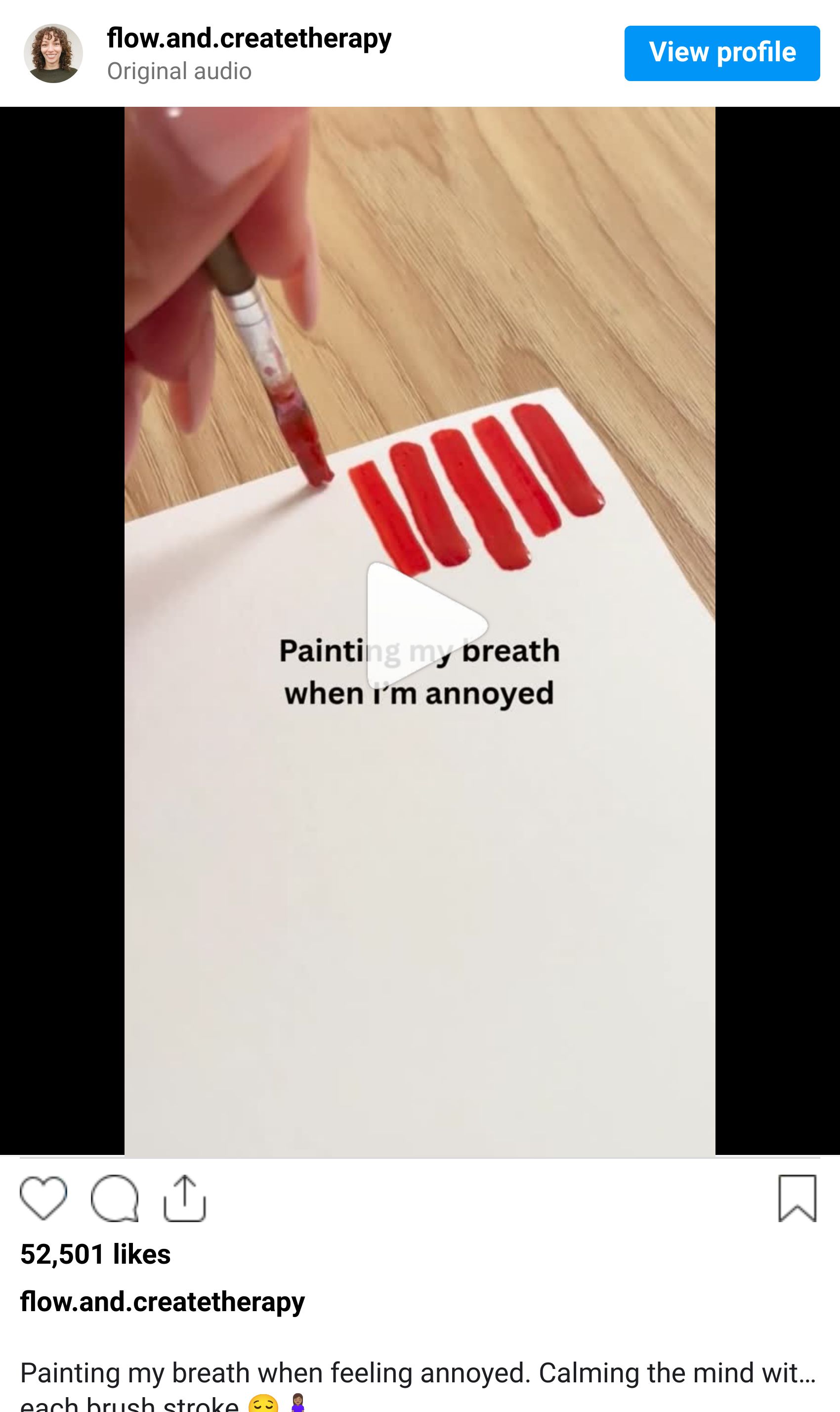
I loveeee the idea of painting your breath when you’re feeling annoyed (or anxious or any negative feeling, really).
We know deep breathing 😮💨 is good for us. We also know artistic activities like painting 🎨 can support mental health. So combining both is definitely healthyish-approved 👍.
⚡ Neural hacks
Directions: Copy, paste, and fill in the prompt below to create a personal early morning sun playlist. Getting early morning sun is suuuper healthyish, and this playlist can help with the hardest part: getting out the door.
Act as a playlist curator who knows how to build a vibe.
Help me create a personal early morning playlist that makes me actually want to get outside and get sunlight first thing in the morning. Ask me a few quick questions about my music taste, ideal morning vibe, typical energy levels, and whether I want the playlist to feel calm, cinematic, joyful, energizing, nostalgic, or main-character-y.
Then build me a 10–15 song playlist with a clear flow: easing out of bed, getting dressed, stepping outside, walking into the morning sun, and coming back feeling a little more alive.
Make it specific to my taste, but include a few fresh picks I may not already know.
🍿 Brain snacks
Healthline (acquired my first company, Greatist) launched an AI bot 🤖
A cool protein challenger market map
Study links colon cancer in young people to too much omega-6 from processed foods (and not enough omega-3 from nuts, fish, legumes)
The FDA approved its first new sunscreen ingredient in 20+ years, called bemotrizinol--and is supposedly less absorbed into the skin
Protein bar co Stars + Honey raises $24M (I tried them, but they weren't my fave)
AG1 is launching a new version with 5g of creatine
Thereabody launched CryoTherm Palm, built to cool your hands down mid-workout... which seems niche?
Disney is working with Philips to make MRIs for kids better
Mark Hyman does NOT like Crumbl's dirty sodas
Looks like Summer Health (led by awesome friend & 5HT reader Ellen DaSilva!) pivoted to Function Health for kids
Sports betting is on the rise... and so's addiction to it. (And yes, there's a telehealth solution to this!)
Most clicked last week: The one on vagina-maxxing (ironic, especially given the whole theme was NOT maxxing anything)
Shoutout to Brian V., Christy C., Emily Z., Sian F., Katherine L., Bret V., Chelsey S., Ross H., Vanessa C., Webb K., & J. Spoor for sending emails or contributing to 5HT+ Slack community!
Want in on 5HT+? Two referrals get you in. Share your unique code, and join the chat. → {{ rp_refer_url }}
👋 Who are you again? I’m Derek Flanzraich—founder of two venture-backed startups in Greatist (👍) and Ness (👎). I’ve worked with brands like GoodRx, Parsley, Midi, Ro, NOCD, and Peloton. I now run Healthyish Content, a premium health content & SEO agency (among other things).
Every Thursday (and now Sunday!), I share healthyish things I feel strongly about. (Disclaimer: I’m more your friend with health benefits. None of this is medical advice.) Also some links are affiliate links, but they influence my decisions zero.
Oh, you also feel strongly about some health things? Hit reply—I’d love to hear it.